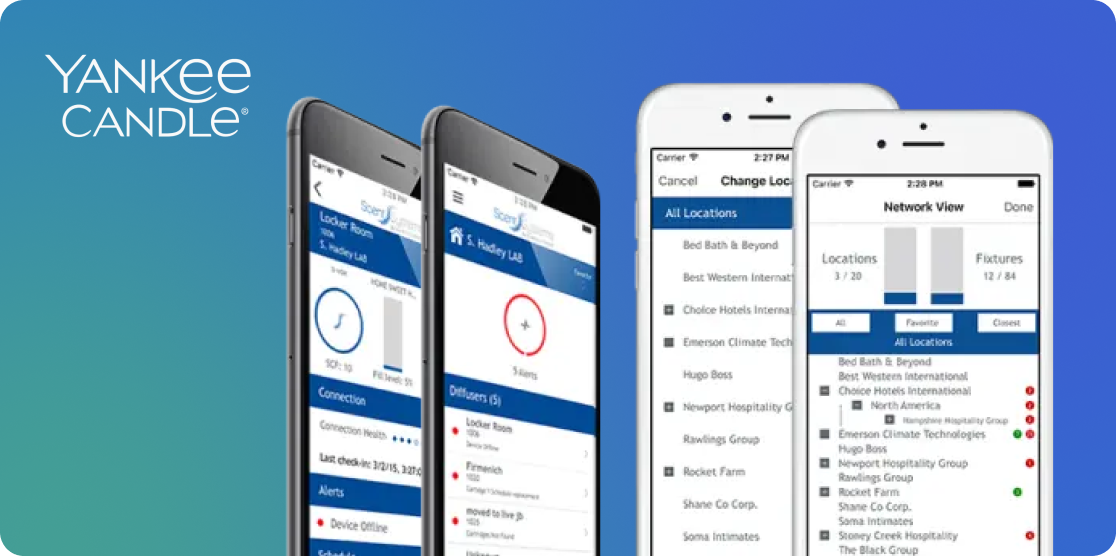
The architecture started with the service agent's job, not the product's feature list. Walk a service round. Open the app. See every station in the route, healthy or not. Drill into a station — fragrance level, liquid level, temperature, humidity, schedule. Make the call: refill, reschedule, retune the concentration, mark resolved. Move to the next station. A whole route in a coffee break.
Underneath, the M-to-M cloud was streaming telemetry from every device continuously, and the agent UI was the surface that made that flow legible. Every screen carried one live signal and one available action — no nested menus, no preference panels burying the controls. The agent never had to remember where a setting lived; the screen they were already on was where the next move belonged.
The harder design decision was what to hide. A station has a long tail of low-level controls — most of them useless to a working agent on a route. The IA's job was to surface the few that matter ninety percent of the time, push the rest into a deliberate "advanced" surface, and never let the everyday flow get cluttered by the once-a-year edge case.