A community built by physicians.
Sermo started when a group of doctors wanted somewhere honest to seek advice and trade opinions. The first version was a desktop forum, verified-only — physicians talking to physicians, nobody else in the room.
Sermo asked us to take a forum-era product where physicians traded opinions on cases and politics — and rebuild it as a mobile-first social network ready for an international launch. Fourteen months later it was carrying real conversation across 150 countries.
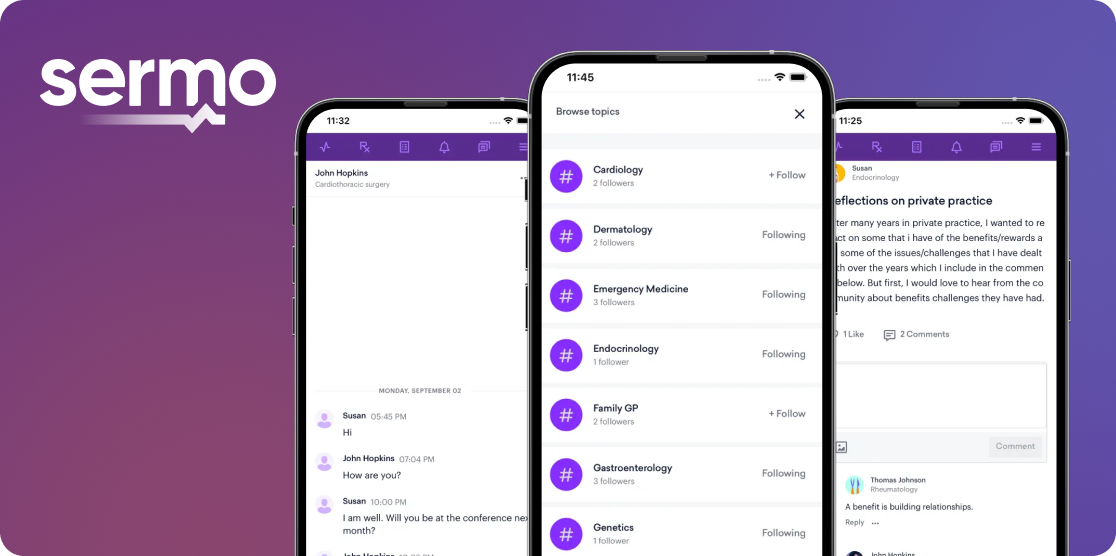
In 2005 a group of physicians wanted an online community to seek advice and connect with other doctors — Sermo was born. In Latin, sermo means conversation, and it became exactly that: a physician-first place to share ideas, debate cases, and weigh in on the politics shaping medicine.
Sermo started when a group of doctors wanted somewhere honest to seek advice and trade opinions. The first version was a desktop forum, verified-only — physicians talking to physicians, nobody else in the room.
Members logged on to surface unfamiliar cases to other specialties, debate the policies shaping the practice, and get second opinions from clinicians outside their own hospital. The site's value was the candor.
By the time Sermo came to us, the desktop forum was past its prime. The goal: move the community into a social-network paradigm — feed, follow, comment threads, real-time activity — and ship it ready for an international launch.
“They took the time to understand our target and what we wanted to accomplish. They did the research.”

A mobile app for clinicians is a different brief from a consumer social network. The audience is busier, more skeptical, and — in many of the markets Sermo wanted to enter — only reachable on a phone.
Sermo was preparing to step outside the US for the first time. The mobile app had to be the front door — in some markets, physicians only access the internet from a phone.
Physicians are trained on forms, charts, and structured records — not infinite-scroll. The app had to bridge the old behavior and the new social paradigm without losing either group.
Getting any consumer-grade social product responsive across the device range a global physician audience actually carries — that's where most of the engineering effort went.
The IA shift wasn't decorative. We were taking a content model physicians knew — threaded forum posts and structured profiles — and rebuilding it as something a smartphone-native social audience would recognize immediately.
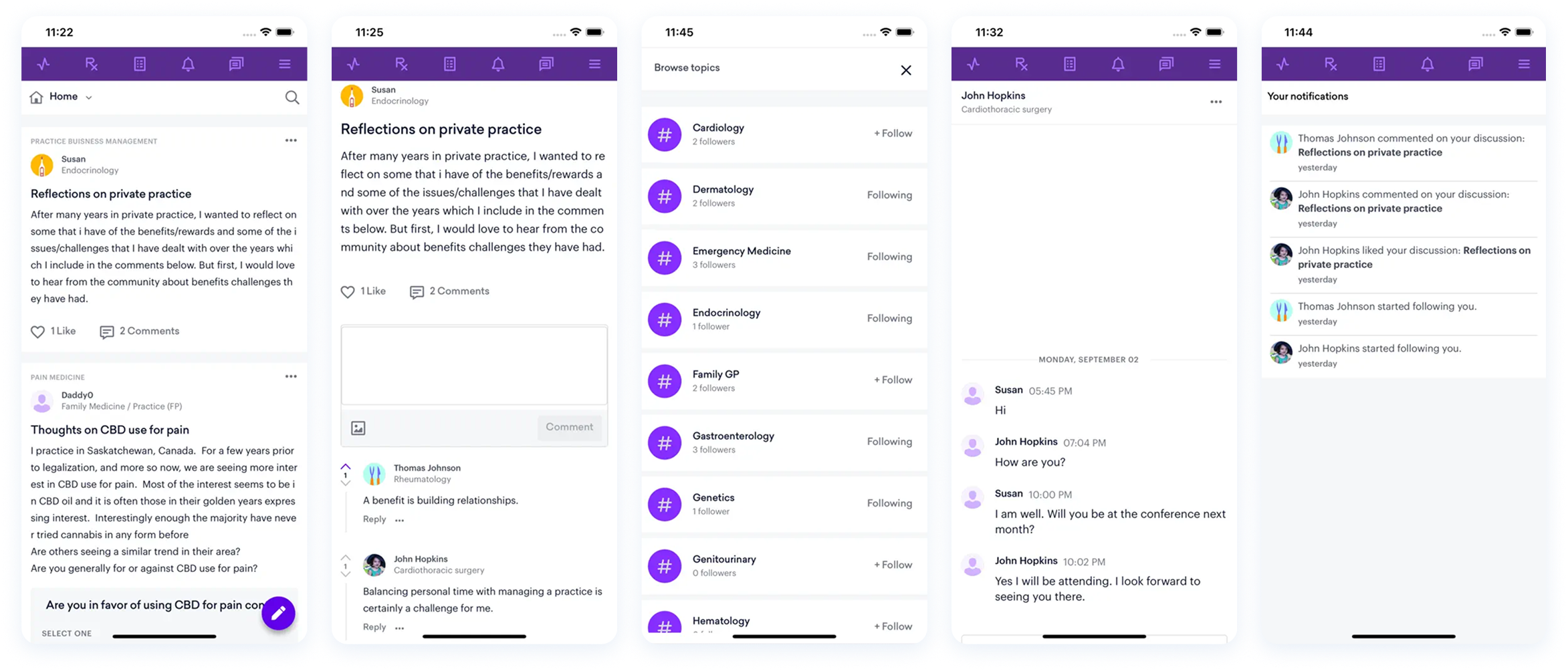
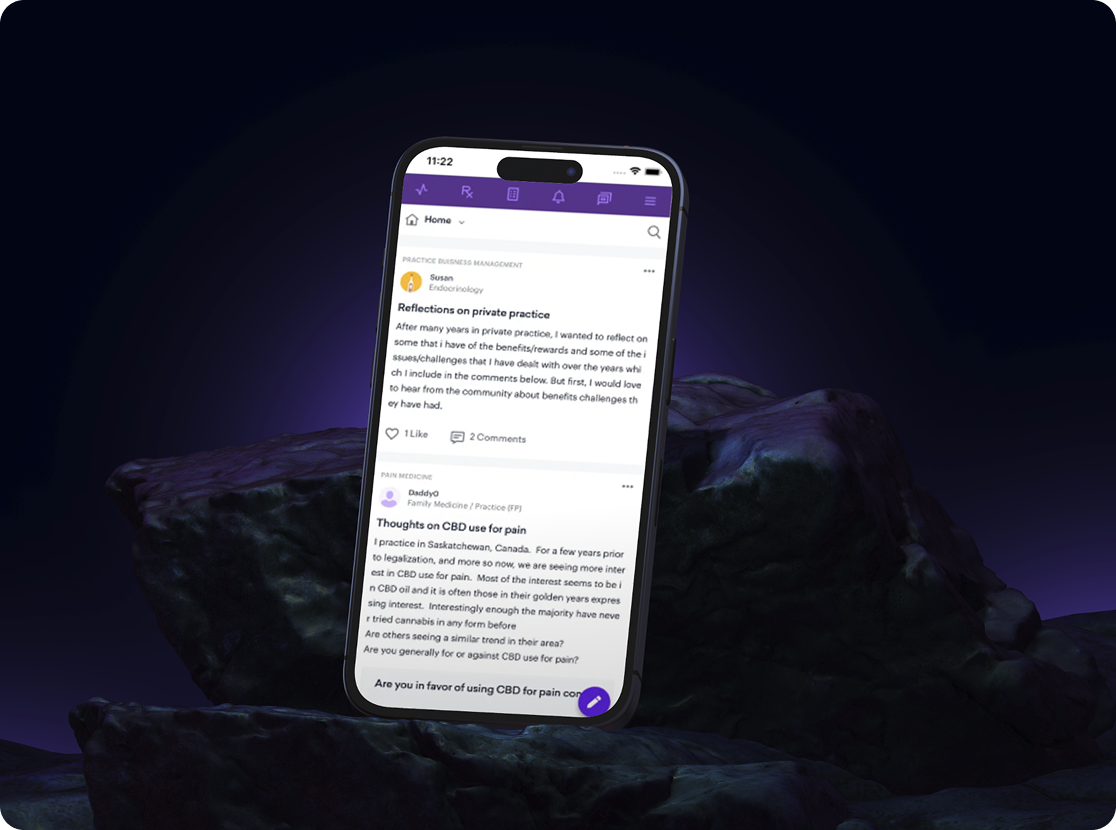
Rocket Farm introduced a new paradigm for consuming user-generated content in the Sermo app. Clients — pharma companies, research groups, Sermo itself — needed to push their own content and offer actions the community could participate in (such as surveys). The activity feed became the load-bearing surface: every piece of new content, every action available to the user, every signal that something was happening, flowed through it.
Physicians are traditionally used to viewing forms — structured fields, clear hierarchy, predictable inputs. An activity feed is a different cognitive load. We bridged the two by carrying form-like clarity into every card in the feed: a clear author, a clear question, a clear action. The result is a feed that scans like a social network and reads like a chart.
The work moved fast because the requirements moved fast. Scope shifted as Sermo got closer to launch and learned what international physicians actually wanted. The IA had to be flexible enough to absorb that without rewrites — and stable enough that the engineers building on top of it weren't chasing the floor.
“Rocket Farm did a good job reacting to requirement and scope changes. There were challenges that came up all the time, and everyone reacted well to them.”
The UI had to feel like a social app a physician would actually open between patients — fast, scannable, never showy. Three rules ran every design review.
Intuitive patterns from the social apps physicians use off-clock — feed, follow, voting, comment threads — became the foundation. No invented gestures, no learning curve, no app that felt clever for clever's sake.
Cards in the feed carry one author, one question, one action. The visual hierarchy holds up at a glance on a phone — between patients, in a hallway, on a commute — without the user having to stop and parse it.
Real-time voting and honoraria for expertise built the loop: a physician answers a colleague's case, the community votes it useful, the contributor gets credit. The UI keeps that loop visible so the value of being a member is felt every session.
The first release of the new Sermo app moved the entire community into a social-network paradigm — feed, follow, vote, earn — without losing the verified, physician-only character members had come for since 2005.
A single load-bearing surface aggregating posts, surveys, client content, and conversations the community is actively engaged in — sorted for relevance, not just recency.
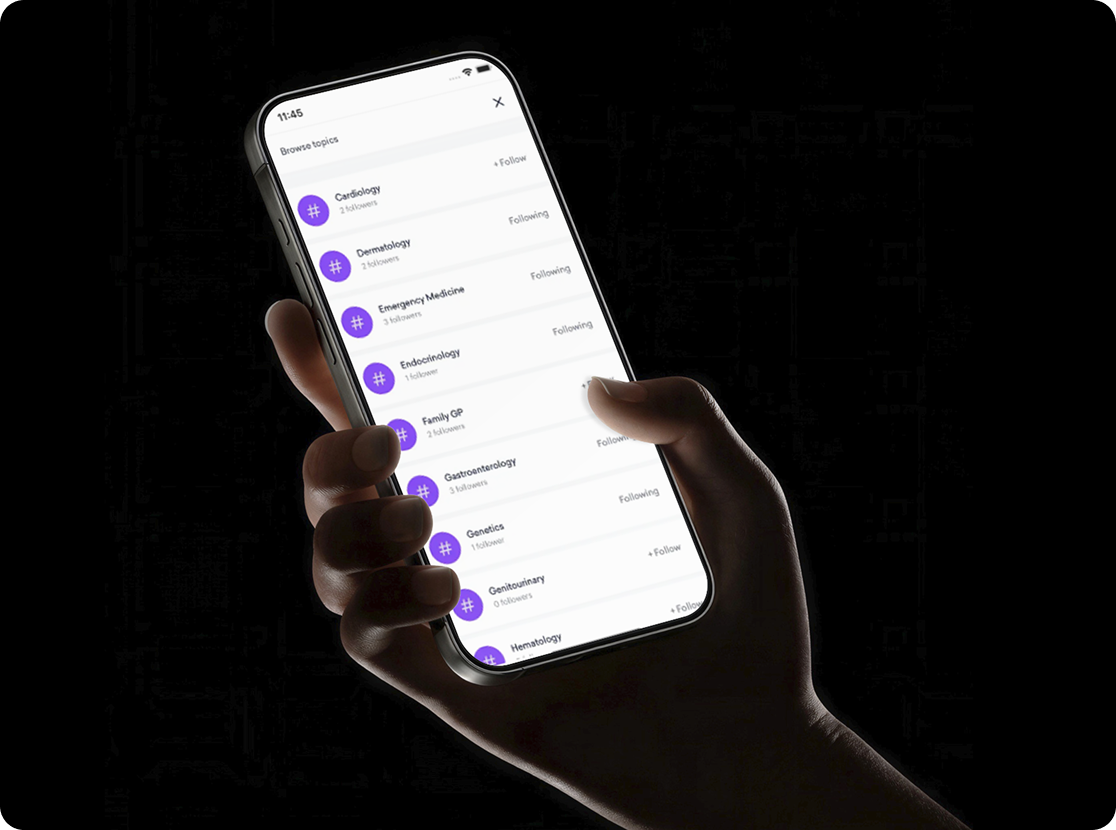
Members can follow individual threads to stay on top of unfolding discussions — the cases that go long, the policy debates that don't resolve, the specialty deep-dives.
Full comment-string view with nested replies, mentions, and notifications — built so a complex case discussion doesn't collapse into noise after the tenth reply.
Live voting on medical trends, treatment questions, and policy issues — results update as physicians weigh in, turning the community into a continuous, instrumented pulse-check.
Members are paid honoraria for providing expertise — answering surveys, contributing case insight, participating in research panels. The earning loop is wired into the feed itself.
Clients can push surveys directly into the feed; participation is tracked, results aggregated, and the contribution rewarded — all without ever leaving the app.
A trustworthy clinical palette — deep teals and saturated blue accents on near-white surfaces — paired with Inter and Poppins for type that scans like documentation, not like a consumer feed.
Aa Bb
Today Sermo is considered the future of doctor-to-doctor interaction. The community keeps growing — more verified physicians, more countries on the map, more pharma and research clients running their work through the feed we built.
Sermo's first true mobile product — feed, follow, comment threads, voting, and honoraria — ready for an international audience the desktop forum was never built to carry.
The app became the platform for Sermo's international expansion. The community has since grown to more than 1.3 million verified healthcare providers across 150 countries — and continues to grow every day.
Requirements moved. Scope moved. Through all of it the team stayed on the work — every challenge resolved on the way to a launch the client describes as exactly what they set out to do.
“It was always a positive and professional experience with Rocket Farm Studios, and most importantly we accomplished what we set out to do.”
If the Sermo story is the shape of your build — a community to scale, a desktop product to move to mobile, an international audience to reach — here's where else our team has shown up across the portfolio.