Case study · Eyebot

A full vision exam in a mall kiosk — ninety seconds end-to-end.

Eyebot brought us a self-serve eye-screening concept and a hardware prototype. We owned the Android kiosk UI, the vision-test flow, the eCommerce handoff into Zenni, and the telemedicine bridge that puts a real prescription in your hand on the way out of the mall.

ClientEyebot
IndustryHealthcare · AI vision
LocationBoston · New England
TimelineMay 2024 → ongoing
ServicesAndroid UI · Kiosk software · Telemedicine
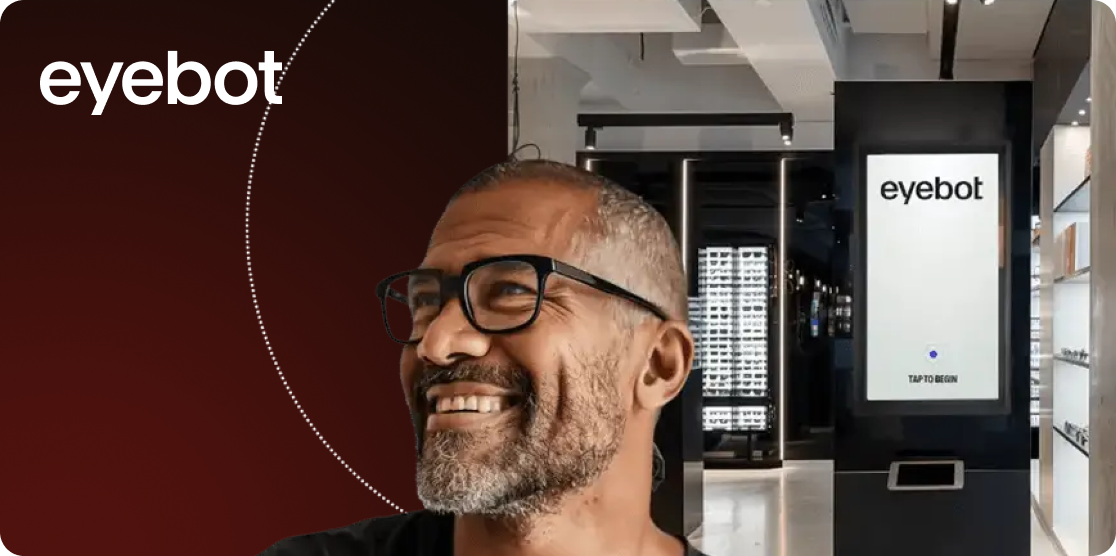
Eyebot — the AI vision kiosk that delivers a full eye screening in about ninety seconds
—— The vision

A vision exam that meets people where they already are.

The optometrist's office is a friction layer most people just don't walk through — long appointments, scheduling, copays, paperwork. Eyebot's thesis: put the exam at the food court, get the prescription on your phone before you leave the mall.

01 / The friction

Half of America skips the exam.

A routine vision check costs an hour, a copay, and a calendar appointment most people don't make. The result is millions of prescriptions that are years out of date — and an enormous downstream market for the glasses retailers waiting on those prescriptions.

02 / The thesis

Self-serve, in public, in ninety seconds.

Move the exam out of the clinic and into the place people already are: a mall concourse, a pharmacy aisle, a campus quad. Make it self-serve. Cut the whole interaction down to about ninety seconds. Put the prescription on a phone, not a paper card.

03 / The wedge

Hardware + AI + a glasses store at the end.

The kiosk is the front door. Behind it: optical hardware, computer-vision models, a licensed telemedicine review, and a direct handoff into a national online glasses retailer (Zenni). The whole loop — exam → script → glasses — happens without anyone scheduling anything.

“They've been very organized and confident in managing everything.”
JM Jack Moldave CTO · Eyebot
—— The challenge

A clinical product that nobody operates.

There's no technician behind the kiosk. The product has to read the room, walk a first-time user through a sequence of medical steps, and hand off cleanly to a licensed clinician — all in about the time it takes to order coffee.

Self-serve, medical-grade

No operator. No assistant. The user walks up cold, follows the instructions, sits the right distance from the optics, and produces a usable result. The UX is the technician.

Ninety seconds. End-to-end.

From walk-up to finished screening, the whole interaction needs to fit in about a minute and a half — fast enough that a passerby will actually do it rather than walk on.

A real prescription on the way out

The result isn't a casual screening; it's the start of a licensed prescription. That means a clean telemedicine handoff and a retail loop that drops glasses into the user's cart — all from the same session.

—— Design · information architecture

Every screen earns its fifteen seconds.

Ninety seconds across six surfaces means each screen gets about fifteen. The IA wasn't designed for completeness — it was designed for momentum. Get the next correct action in front of the user with no decoration.

We sat with the hardware and wrote down every step the user has to physically and cognitively perform — approach the kiosk, agree to the screening, position themselves, complete each test, receive the result, and exit into the eCommerce flow. Every step became one screen. Every screen got one decision. The architecture was specified before any pixel was final, so the engineers downstream could build against a stable plan instead of a moving target.

From there, every screen got a single job and a single failure mode. If the user isn't standing in the right place, the screen reads that and corrects it — it doesn't ask. If the screening times out, the failure unwinds cleanly to a recoverable starting point — it doesn't strand the user in the middle of a medical flow. The IA carries the responsibility a clinician would carry in a normal exam: knowing what to do next, knowing what to do if something goes wrong.

The work is ongoing. As more units roll out, the team is instrumenting every step of that flow — where users drop off, where the optics confuse a first-timer, where the telemedicine handoff stalls — and feeding that signal back into the next iteration of the IA. The kiosk software gets better the more it runs.
“RFS saved us time, technical debt, and the quality of their work is very high.”
JM Jack Moldave CTO · Eyebot
—— Design · UI

Big targets. Bigger trust.

Kiosk UI rules and clinical UI rules collide in this product. Three principles ran every design review — pick the right next move, look like a medical device, never look like a mall game.

01

One screen, one decision.

Every screen offers exactly one action a sane first-time user is going to take. No menus. No nested settings. If the user is staring at the screen wondering what to do, the screen has already failed.

02

Touch targets sized for strangers.

No one in a mall has been trained on this app. Targets are large, hit areas forgiving, copy direct. The interaction quality has to work for a sixty-year-old with cold hands and reading glasses on a chain.

03

Reads as medical, not retail.

The screen has to project the same trust a clinic exam carries. No animations that look like a video game. No gamified scoring. No "tap to win." Clinical clarity at every step, because the prescription on the other end of this is real.

—— What we built

Six surfaces. One vending-machine clinic.

The shipping unit is a coordinated stack of UI, optics, scheduling, eCommerce, and telemedicine — running on a tablet bolted to a kiosk in a working mall. Here's the scope our team owns.

Android kiosk UI

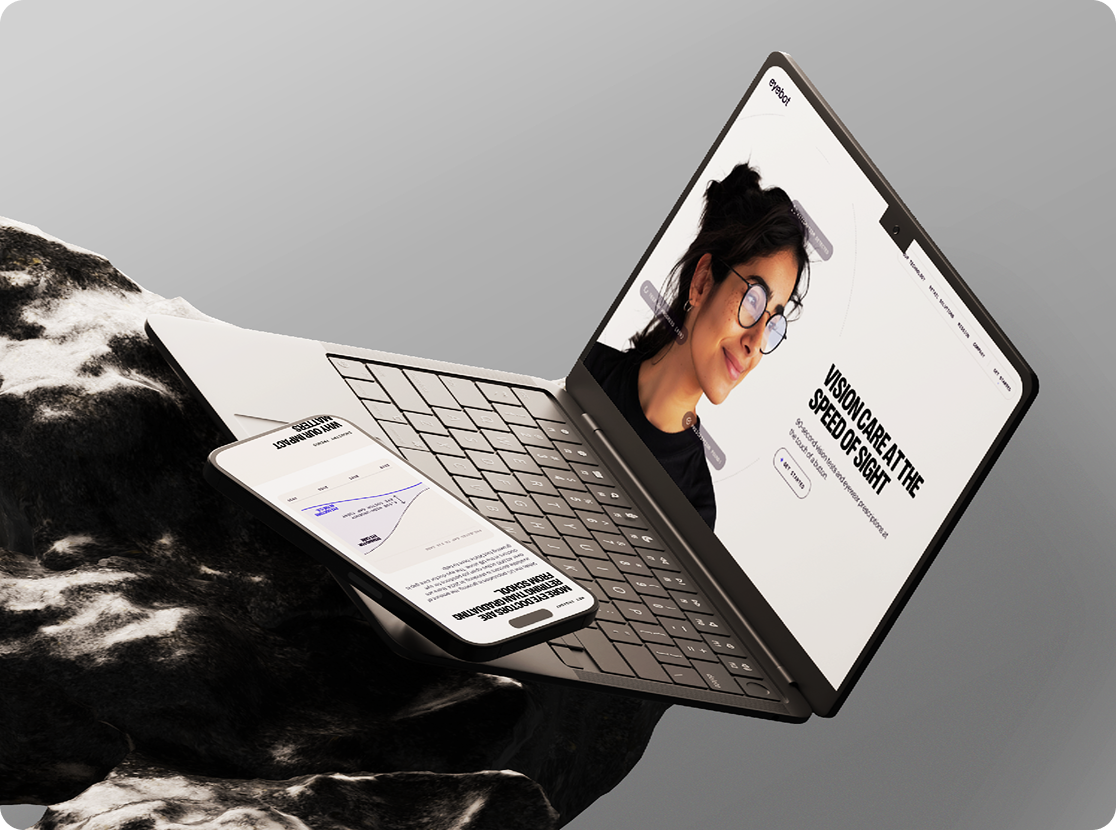
The full touchscreen interface running on the kiosk's Android tablet — from idle attract loop through the entire screening sequence and into the post-exam handoff.

Vision-test flow

The screening sequence itself — instruction screens, positioning prompts, test stages, and the result surface. Specified end-to-end before a pixel was final, then refined against real walk-up users.

Zenni eCommerce handoff

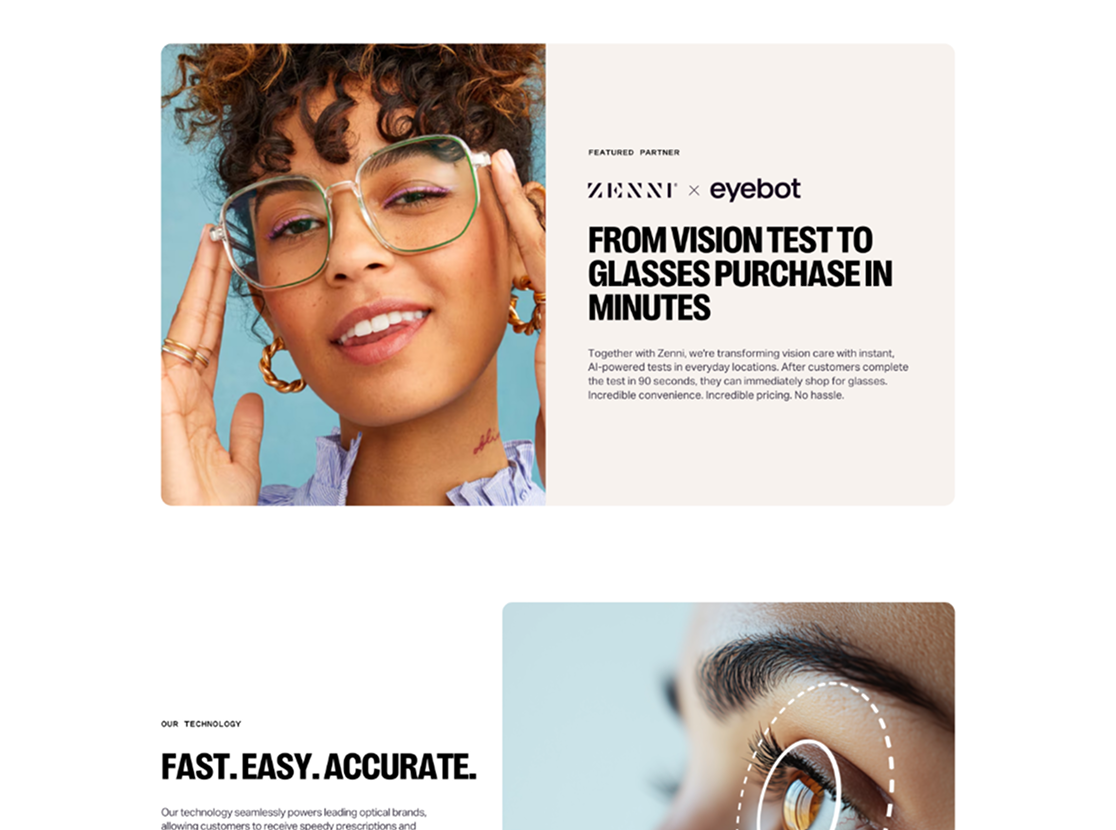
When the screening is complete, the user gets a clean handoff into Zenni — an integrated retail bridge that takes the prescription the kiosk just produced and lands the user on a glasses-cart that already knows about it.

Telemedicine bridge

The screening result is reviewed by a licensed clinician on the back end — the telemedicine surface, the queue, and the bridge from the in-kiosk session to the licensed review are all part of the build.

Session orchestration

Every walk-up becomes a managed session with a strict ninety-second budget — kiosk lock-in, recovery states, idle resets, and the telemetry that lets the team see exactly where every session lands.

Operations console

A back-of-house surface for the Eyebot ops team — monitor each kiosk's uptime, peek at sessions in progress, push remote configuration, and triage any unit that's gone quiet in a mall corridor.

—— The outcome

Two units live. Eight more on the way.

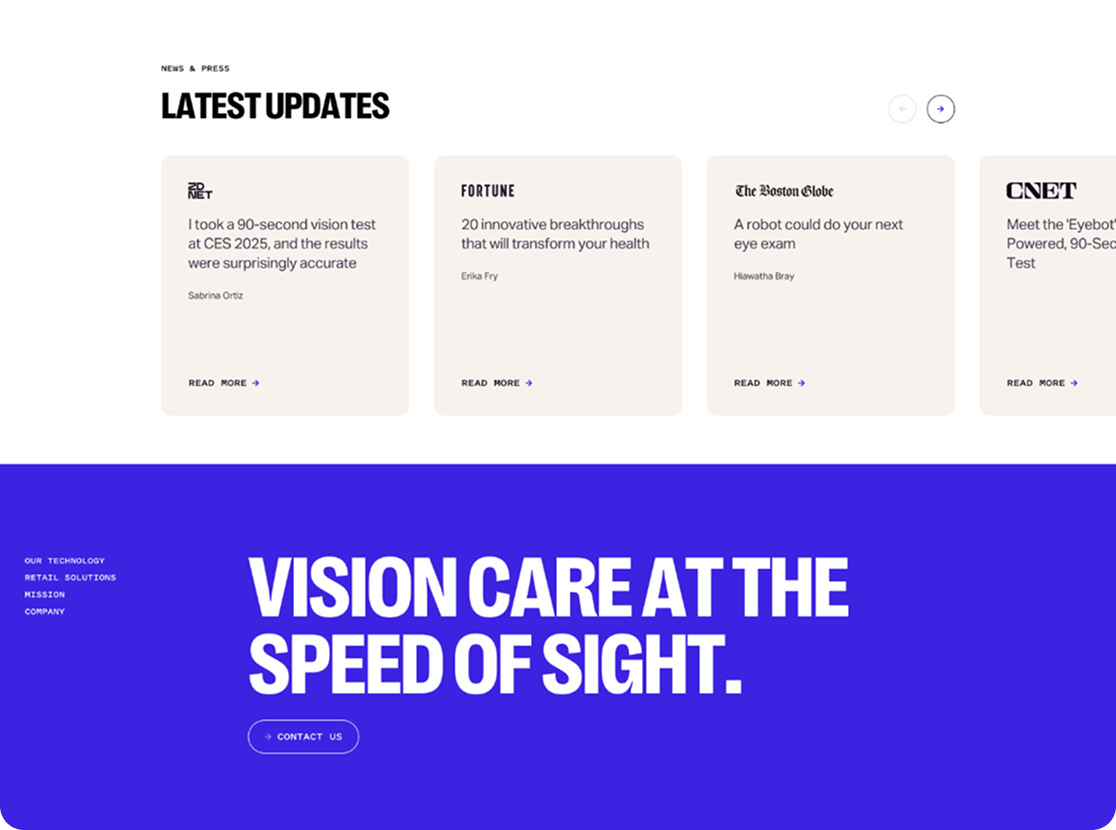
Two Eyebot kiosks are live in Boston-area malls today, with eight more being rolled out across New England. The product is no longer a hardware prototype on a workbench — it's running in front of real walk-up users, in real retail spaces, every day.

01 / What we shipped

A clinical kiosk that runs unattended.

A working Android kiosk product — UI, test flow, eCommerce handoff, telemedicine bridge, operations console — running in live mall locations without a Eyebot technician on site. The whole loop, every day, on real hardware.

02 / What it carries

A real prescription, every session.

Each screening ends in a licensed-clinician-reviewed result and a clean retail handoff into Zenni. The thing the user walks away with isn't a result page — it's the start of a real glasses order on a real device.

03 / What's next

From Boston malls to a footprint.

Two units live, eight rolling out, more pipeline behind that. The build is ongoing — every kiosk in the wild is feeding the next iteration of the software the rest will run on.

“RFS saved us time, technical debt, and the quality of their work is very high.”
JM Jack Moldave CTO · Eyebot
—— On the screen

A glance at the surfaces that ship.

—— More from the studio

Three more apps. Three more outcomes.

If the Eyebot story is the shape of your build — connected hardware, a real-world UX, a regulated outcome — here's where else our team has shown up across the portfolio.