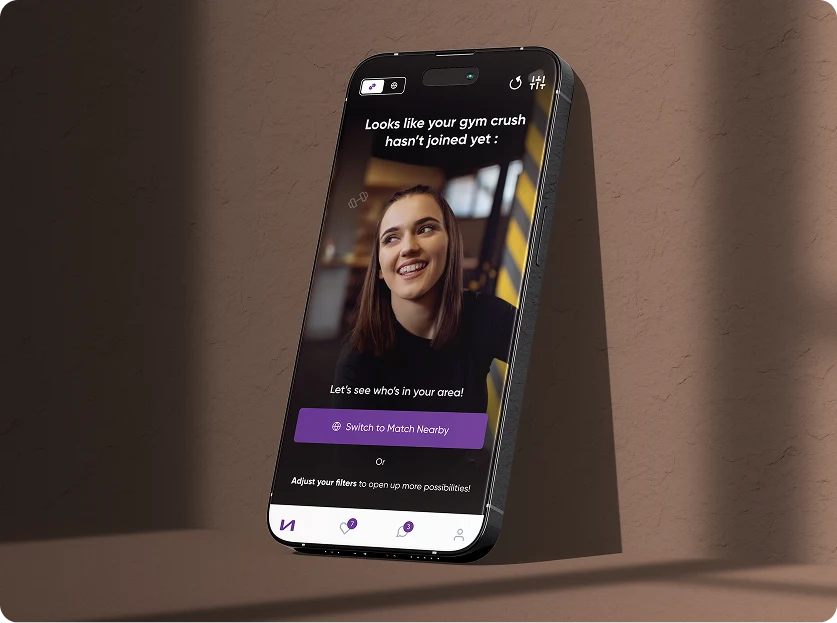
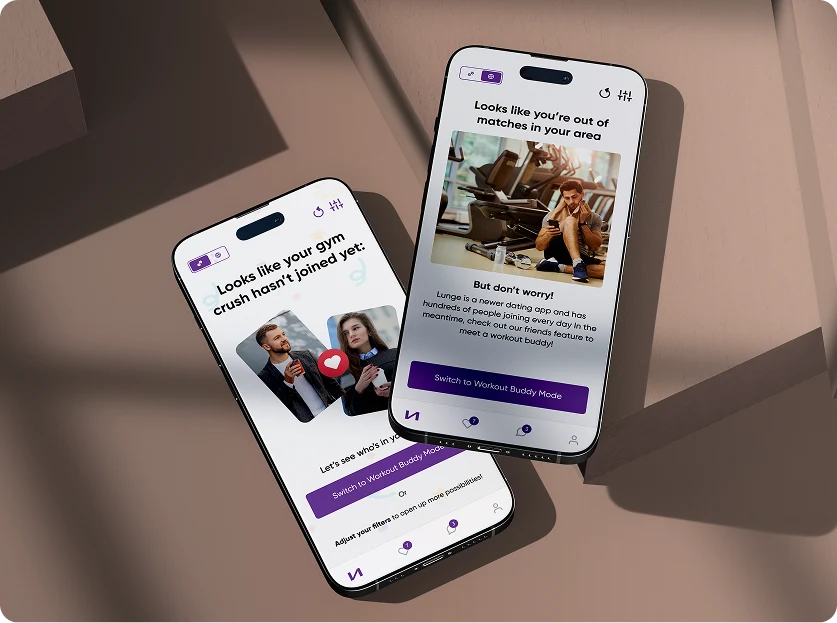
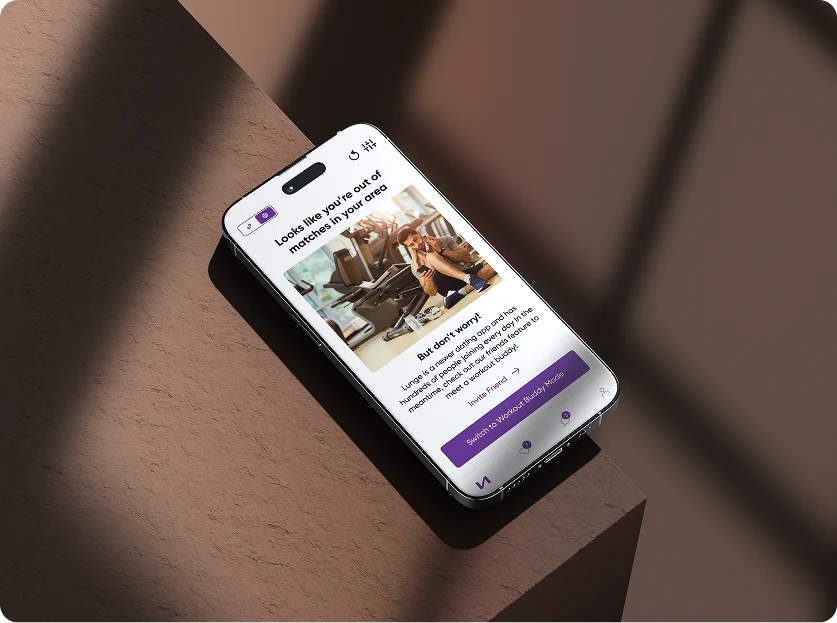
Case study · Lunge

The dating app helping gym lovers find their match — and their PRs.

Lunge came to us with a dating-app thesis the general apps don't serve: the people whose week revolves around a gym, a barbell, and a PR. We owned the iOS build, the generative-AI layer inside the profile and chat surfaces, and the performance-marketing stack the app launched on.

ClientLunge
IndustryConsumer · Dating + Fitness
PlatformiOS (iPhone)
StageMVP → live in market
ServicesiOS · Gen AI · Performance marketing
Lunge — the dating app helping gym lovers find their match and their PRs
—— The vision

A dating app where the gym is the conversation.

For people who train seriously, the gym isn't a hobby — it's the structure of the week. The general dating apps don't surface that identity. Lunge's premise: build the app where it leads the conversation, not buries it under a Spotify-anthem question.

01 / The audience

Gym lovers have a different week.

A training routine isn't a hobby slot — it's the calendar everything else fits around. Morning lifts, programmed splits, recovery days. The compatibility question for this audience starts with whether the other person trains, not what podcast they like.

02 / The category gap

General dating apps don't surface it.

Profile sliders for "active" and a single fitness emoji don't carry the difference between a casual gym-goer and someone training for a meet. The signals serious lifters care about — split, gym, current cycle, last PR — are missing from the surface.

03 / The bet

Build it once, properly, on iOS.

The Lunge thesis was a focused-vertical play: one platform, one audience, one product, done well. Get iOS right, get the AI layer right, and run a performance-marketing stack hard against the people most likely to convert.

—— The challenge

Three disciplines, one coherent product.

The hard part wasn't any one surface. It was getting iOS engineering, generative-AI integration, and performance marketing to feel like the same product instead of three vendors stitched together.

A dating app, not a gym app

Lunge needed to nod to gym culture without becoming one. The visual language, the copy, the surfaces — they all had to read as a dating product first, with the fitness layer earned through identity, not slapped on through icons.

AI that helps, doesn't replace

Generative AI in onboarding and chat without taking over the human conversation. The model writes the prompt; the user writes the answer. The model suggests an opener; the user decides whether to send it.

Growth on day one

A dating app's first 90 days set whether the supply side ever catches up. The performance-marketing stack — analytics, attribution, install funnel, lifecycle — had to be ready at launch, not bolted on after.

—— Design · information architecture

Profile, feed, chat. Three surfaces, doing one job.

The IA's job was making the gym identity feel native to the dating loop — not a separate "fitness" panel a user has to opt into. Three load-bearing surfaces, each carrying gym signals where they belonged.

The profile surface set the tone. Beyond the standard dating-app fields, Lunge surfaces the parts of gym identity that actually predict compatibility: training style, split, primary lifts, the gym you actually go to, the cycle you're currently running. The fields are optional — a profile without them still works — but the people Lunge is for fill them in because they're the parts that matter.

The match feed carries those signals up. Sorting and filtering are tuned to fitness compatibility without becoming a fitness search engine — it's still a dating feed first. A user can prefer training partners over coffee dates, or both. The feed reads people who train and people who don't with different weights, because the audience asked us to.

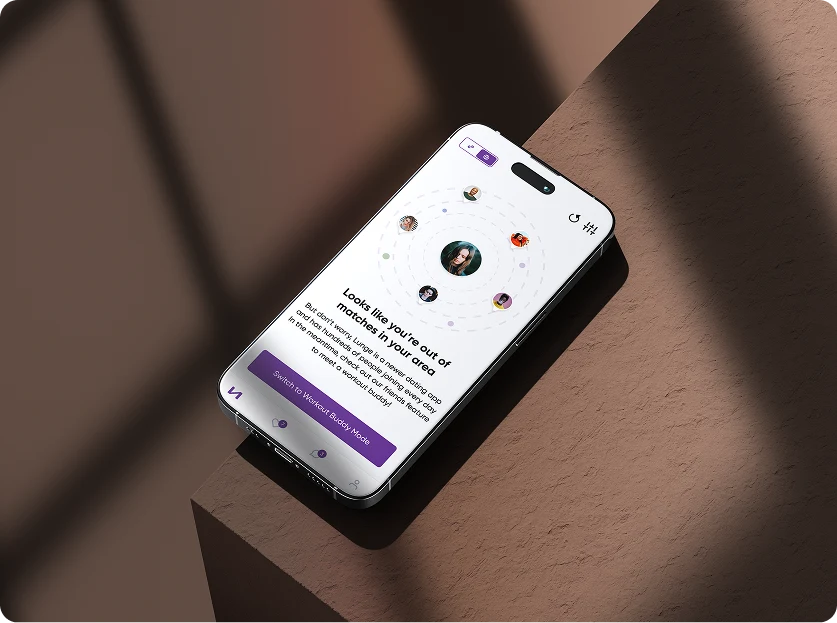
Chat is where the generative-AI layer earns its space. The model offers conversation starters grounded in the things both users actually put on their profile — a shared gym, an overlap on a split, a similar PR target. The model doesn't carry the conversation; it offers the first line. The user decides whether to send it and what to type after.
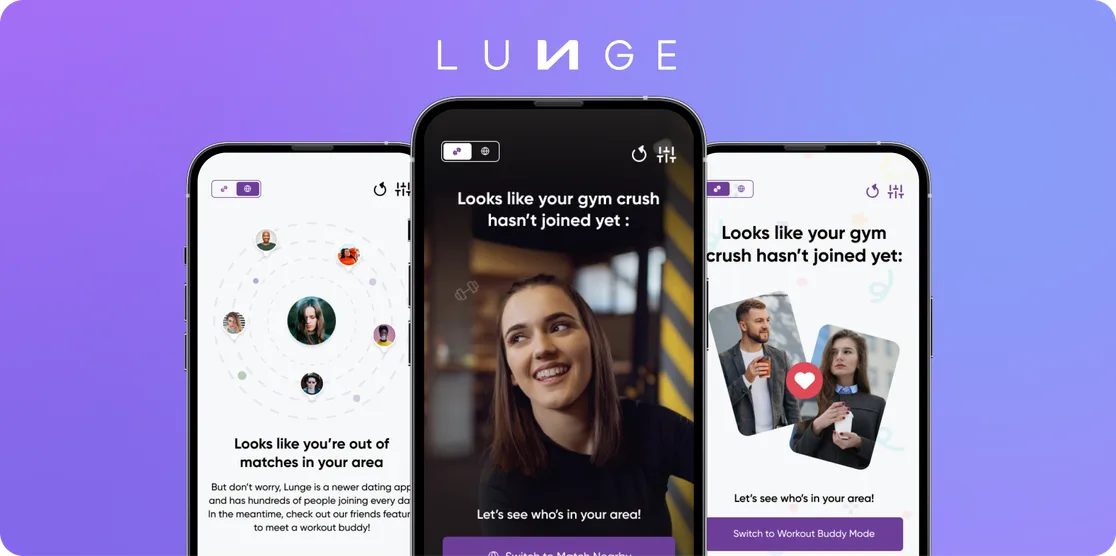
—— Design · UI

Gym signals. Not gym uniform.

Three rules ran every UI review — read as a dating app, never as a fitness app, and keep the AI a helpful tool the user is in charge of.

01

Dating first. Gym earned.

The first impression of every screen had to read as a dating product. The gym layer earned its weight through the user's own profile, not through iconography. No barbells in the chrome, no rep counts on the home screen.

02

AI suggestions are defaults, not decisions.

Every generative surface — profile prompt, conversation starter, bio polish — is a suggestion the user can accept, edit, or ignore. The model never sends a message for the user, never auto-fills a profile field. The user is always the author.

03

Native iOS, native gestures.

No cross-platform abstraction layer. iOS-native components, iOS-native animation curves, iOS-native gesture vocabulary. Lunge had to feel like an app that grew up on the iPhone — because the audience uses it as such.

—— What we built

One iOS app. Three disciplines underneath.

A single product surface for the user — engineered as three coordinated work streams behind the scenes: iOS build, generative-AI integration, and the performance-marketing stack the launch ran on.

Native iOS app

A single iPhone build — native Swift, iOS gesture vocabulary, App Store distribution. No React Native, no cross-platform wrapper. Lunge is an iPhone app the way iPhone apps are supposed to feel.

Gym-signal profile creation

Optional, expressive profile fields for the parts of gym identity that actually predict compatibility — split, current cycle, primary lifts, training style, your real gym. None of them required; all of them surfaced if you fill them in.

Gen-AI conversation starters

A generative-AI layer in chat that suggests opening lines based on the actual overlap between two profiles — shared gym, a similar split, a comparable PR target. Suggestion, not auto-send.

Gen-AI profile prompts

In-app prompts that help users write the bits of a profile most people get wrong — a real intro instead of a list of cliches, a real "looking for" line instead of vibes. The model writes the question; the user writes the answer.

Fitness-aware match feed

A feed that reads the same set of profiles through a different lens depending on what the user asked for — training partners, dates, or both. Same product, two intents, both surfaced cleanly.

Performance-marketing stack

Attribution, install-funnel analytics, lifecycle messaging, and growth surfaces — wired in at launch, not retrofitted later. The first 90 days of a dating app are decisive; the data has to be on from day one.

—— The outcome

One coherent product across iOS, AI, and growth.

Lunge is the iOS app in market — a single product surface carrying the gym identity Lunge's audience actually trains around, with a generative-AI layer that helps without taking over, and a performance-marketing stack ready for the first 90 days.

01 / What we shipped

A native iOS dating product.

Lunge is a single iPhone app — iOS-native build, gym-aware profile and feed surfaces, generative-AI assists inside profile creation and chat, and the growth infrastructure to run the launch on. One product, three coordinated work streams underneath.

02 / What it carries

A category nobody else built for.

A dating product where the gym identity isn't an emoji or an opt-in panel — it's the thing the surface starts with. The audience Lunge serves had been making do with sliders and filters on general apps; here, the conversation starts where it actually starts.

03 / What we're proud of

Three disciplines, one product feel.

iOS engineering, generative-AI integration, and performance marketing don't usually feel like the same product when a team is stitching them together. On Lunge they did — and that's the part the studio is quietly most proud of.

—— On the screen

A closer look at the surfaces that shipped.

—— More from the studio

Three more apps. Three more outcomes.

If the Lunge story is the shape of your build — consumer iOS, an AI layer that respects the user, and growth wired in at launch — here's where else the team has shown up.