From competitor to coach.
Bruce came up through Community Rowing in Boston as executive director — the largest public rowing program in the US — then coached the US team at the World Rowing Championships. He'd seen the sport from every seat.
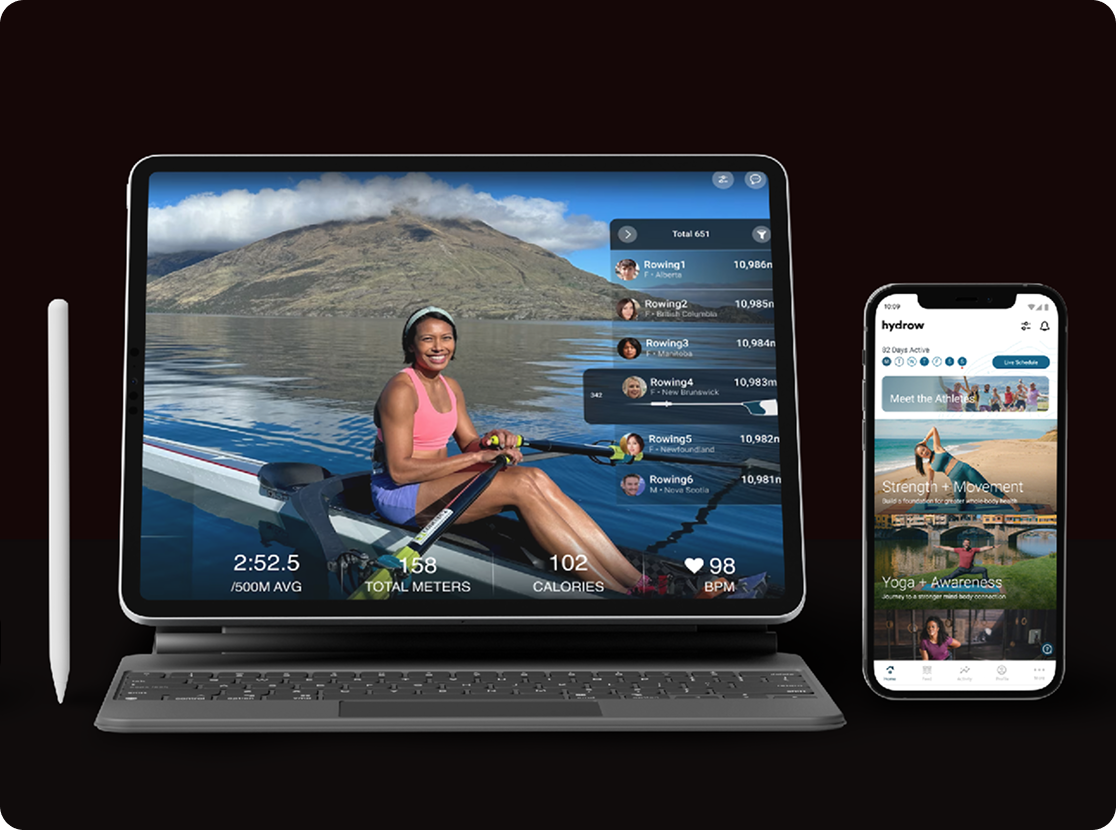
Live-streamed rowing experience with real-time on-water metrics, touchscreen interface, and hardware integration with the rower itself. Six months kickoff to ship — the partnership has run across every funding round since.
Bruce Smith — Hydrow's founder — came to us with a sport thesis, not a fitness thesis. He'd run Community Rowing in Boston as executive director and coached the US team at the World Rowing Championships.
Bruce came up through Community Rowing in Boston as executive director — the largest public rowing program in the US — then coached the US team at the World Rowing Championships. He'd seen the sport from every seat.
What pulls a rower back to the water at six in the morning isn't endurance, strength, or aesthetics — it's a synchronized social act with two hundred years of culture around it. The sport's appeal is the company.
Bruce's bet: if we could get even a fraction of the on-water emotional charge into a connected machine at home, we'd have something nobody else in consumer fitness had figured out how to build.
“I'm convinced that rowing is underutilized not just in health and fitness, but as a tool for creating greater human empathy and connection.”

Rowing's most loyal customers don't talk about reps or splits — they talk about the boat, the morning, the company. Hydrow's question to us was simple: can the at-home machine carry any of that emotional weight?
Most connected-fitness products treat the workout as a problem to solve. Hydrow's bet was the opposite: rowing is a sport where the experience is the point. The product had to carry that.
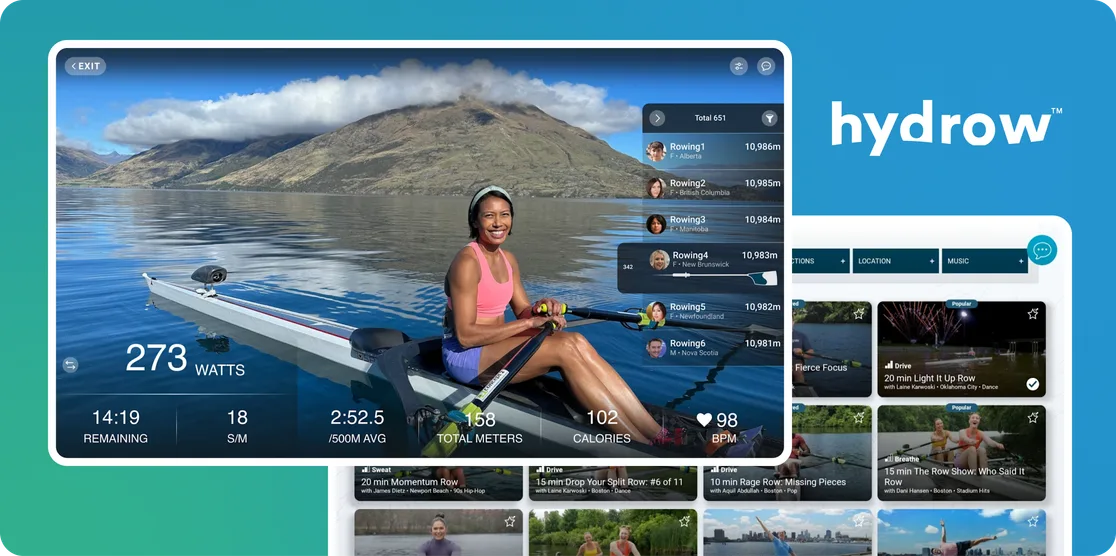
Stream actual rowing footage from real water locations and overlay real-time biometrics that respond to every stroke. New territory at the time — no template to copy.
Hydrow was still-funding in 2018. The unit we shipped had to be demonstratable end-to-end in a real home, against a real workout, in front of the next investor.
Before any pixels were final, we wrote down every state the product could be in and every move a user could make from inside it. The UX wasn't designed, it was specified.
The work started with user personas and screen flows — what does a first-time rower see on the home screen, what happens when a subscription expires, what does the system do when mid-class Wi-Fi drops, how does the post-workout compare against last week. Every screen, every decision point on that screen, every state the screen can be in, documented before any UI was final. Not lo-fi sketches and a long discovery deck — a working specification the engineers downstream could trust.
The team and Bruce ran weekly reviews against the spec. By the end of month one the architecture was solid enough to start building the UI on top of it. By the end of month three the screens were tested in-home. By month six, shipping.
“We had an idea of what the app should be and how it should function. But Dan really helped refine our vision of the app, and we built it in record time.”
Hydrow's hardest UI rule was a negative one: the product cannot feel like a piece of gym equipment. Every screen had to do less, not more.
No timer-front-and-center, no rep counter dominating the screen, no aggressive "now do this" coaching. The negative rule shaped every design review — if the screen started to feel like a treadmill, it went back.
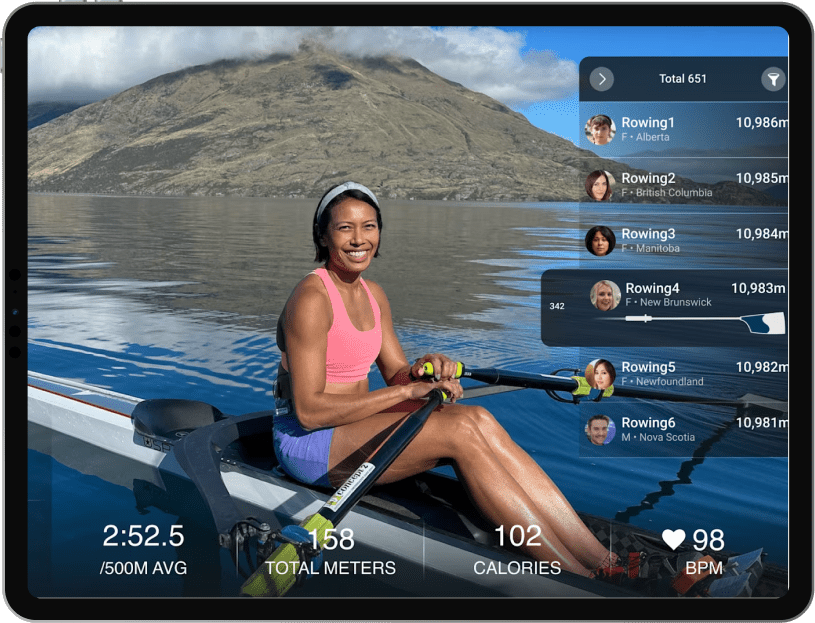
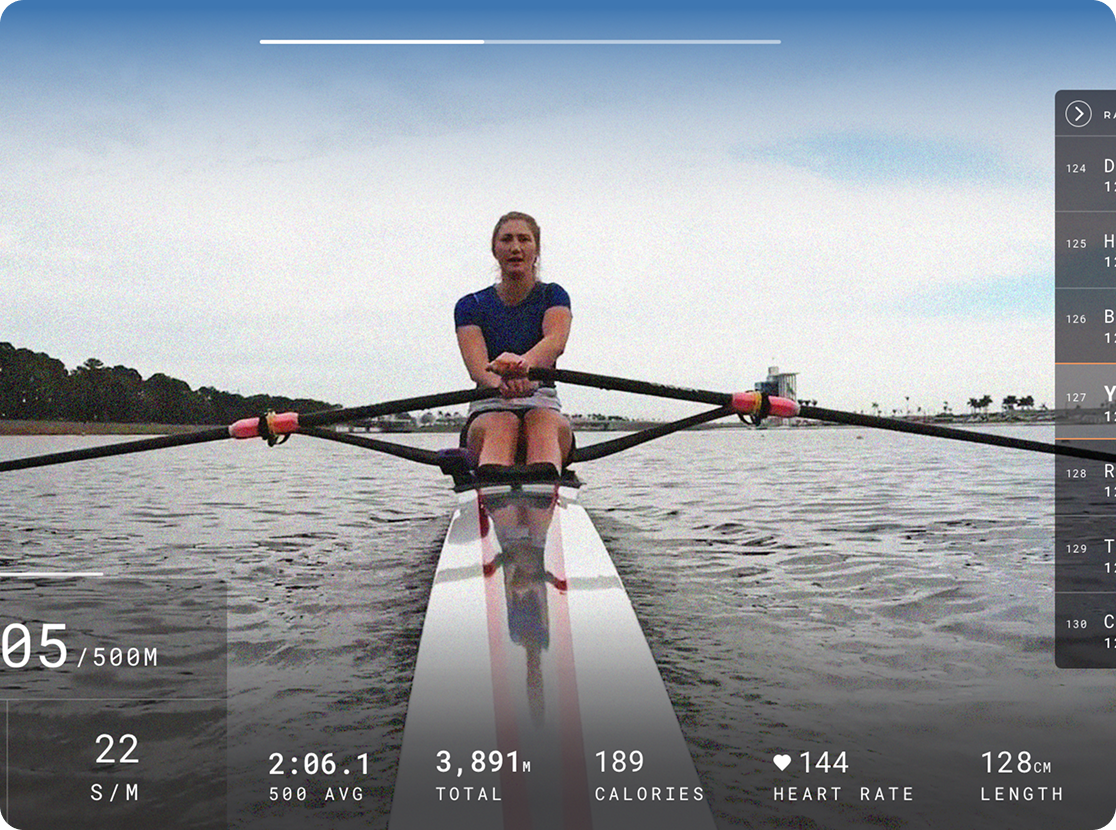
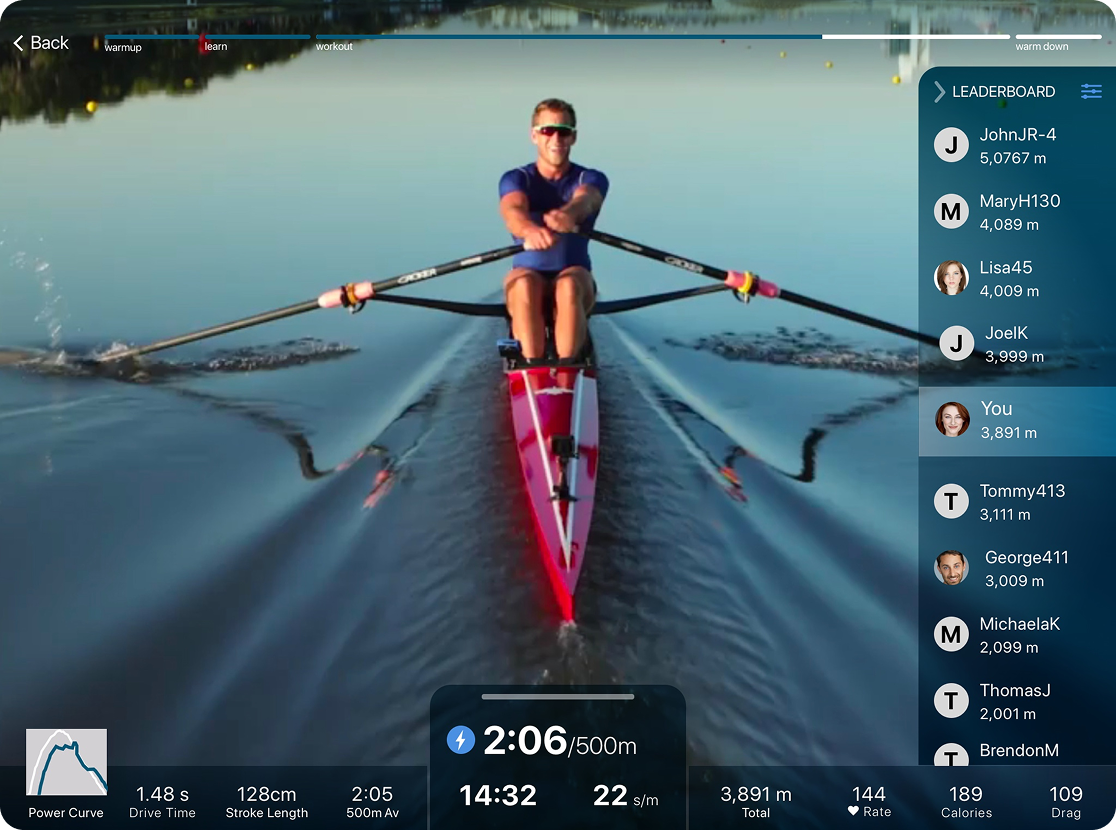
Stroke rate, splits, output, heart rate — all there, but in the corner of the screen the way they'd live in the corner of your eye on the water. When you want them, you look. When you don't, they fade out of the way.
Every iteration was measured against one question: does this make the product feel more like water, or less? Whichever path subtracted the most without breaking the workout won the review.
“We spent a lot of energy and creative process on how to capture the feeling of being outside, the emotional experience of being outside. Making a simple UI is very difficult, but Rocket Farm was amazing at staying true to this.”
The Hydrow experience runs across hardware, an embedded touchscreen, a mobile companion, a live-video pipeline, and a backend that has to be on every time you press start. Here's the scope.
Live-streamed rowing classes filmed on real water — the Charles, the Hudson, the Thames. Stream pipeline tuned to keep the cadence locked, even on home Wi-Fi.
Split times, stroke rate, output, heart rate — fed off the rower's own sensors at every pull. Glanceable on the embedded screen, archived for review later.
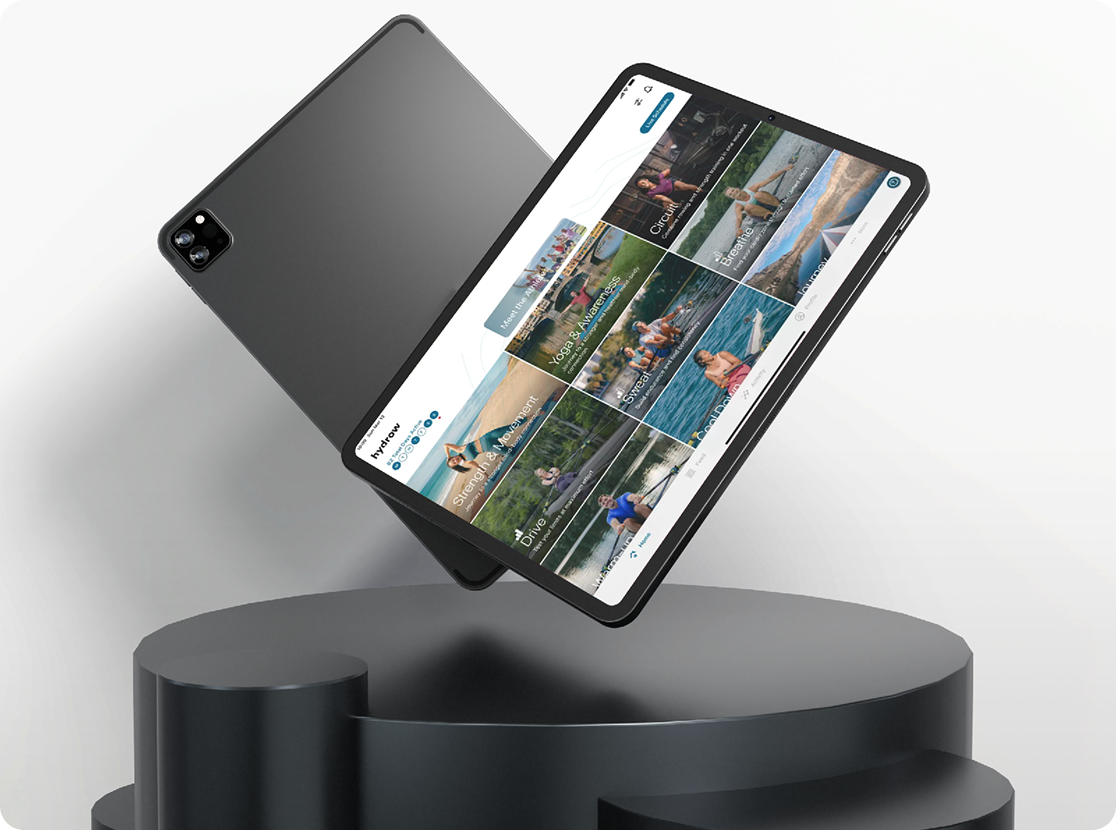
An interface a first-time rower can use without a manual. Hierarchy tested in-home, animation budget kept small, accessible at speed and under sweat.
Two-way bus between the machine and the OS: pull data in (cadence, resistance), push commands out (lights, screen wake, audio). The hardware and the app feel like one device.
Every workout logged, every PR remembered. Trend charts, milestones, and the ability to row "back" against your own past — a feature that turns out to drive a lot of retention.
Video ingest, encoding, scheduling, CDN; user accounts, subscriptions, analytics. Built to support the celebrity-class launch slate Hydrow has run ever since.
A calm, water-blue palette on near-white surfaces — Inter for everything that needs reading. Designed to recede behind the live video, never compete with it.
Aa Bb
We chose a stack the team could ship on in six months and operate for ten years. Conservative on the surface, modern where it counts — and Hydrow's engineers can step into any file without a six-month ramp.
Reactive frontend framework used across the embedded screen UI.
Companion web surfaces — admin tooling and content publishing.
Mobile companion app — iOS + Android from one codebase.
In-machine player surface — video, overlay, and gesture inputs.
Backend application server — accounts, content, subscriptions.
Backend language — data pipelines, video ingest, scheduling.
Real-time services — websocket streams, metric routing.
Cloud + CDN — S3, CloudFront, Lambda, video distribution.
The first Hydrow we shipped was the unit on display at every demo afterward. The product has since carried the company across Series B, C, and D — and into a celebrity-class roster that did not exist when we started.
By the end of the engagement Hydrow had a shipping product that could be demonstrated end-to-end in a real home, against a real workout. That unit became the asset every funding round after was built on.
Funding across Series B, C, and D. Marketplace accolades for the mobile app. A celebrity-class endorsement roster. A Fabletics retail partnership that put the product in stores — out of the niche connected-fitness aisle.
The partnership ran across every funding round. The product Hydrow ships today is still the codebase we put in their hands six months in. That, more than anything else, is what the team is quietly most proud of.
“Our goal was to make the most beautiful workout experience in the world, and we did it.”
If the Hydrow story is the shape of your build, here's where else our team has shown up across the portfolio.